




By Louise Jett
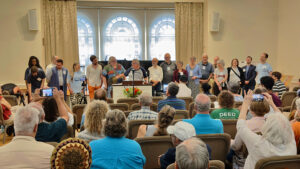
Ethical Culture really shines when principled intention becomes shared action. At the 110th Assembly of the American Ethical Union, members and friends made their shared ethical work tangible through care, adaptability, and a commitment to community.
As participants arrived at the Philadelphia Ethical Society’s historic meeting house, volunteers helped orient newcomers, answered questions, and created the conditions for connection to unfold. For Micheleen Karnacewicz, a valuable member of Ethical Culture, serving at the reception desk became a meaningful way to live the movement’s values.
“Every time the front door opened, I had an eager smile as I greeted the new arrivals,” she reflected. Through that steady rhythm of welcome, relationships began to take shape before the first session even started. Each greeting became an invitation into relationship, and each conversation helped transform the gathering from a schedule of events into a living community.
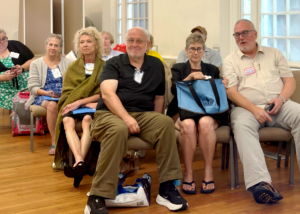
Across the weekend, similar acts of stewardship shaped the Assembly’s atmosphere. Volunteers coordinated logistics, facilitated dialogue, supported programming, and ensured that participants could navigate both the physical space and the emotional experience of gathering together. Much of this work remained unseen, yet it formed the foundation that allowed the Assembly to flourish as a space of reflection, learning, and connection.
The meeting house itself offered both inspiration and challenge. Its historic architecture reflected the longevity of Ethical Culture’s presence in Philadelphia, while its limitations required careful planning to ensure accessibility for all participants. Volunteers worked collaboratively to adapt schedules, support mobility needs, and respond to evolving circumstances with patience and creativity. Through these efforts, ethical community was sustained through steady, attentive care.
In the final days before the Assembly, that shared commitment was tested. Lead organizer Vandra Thorburn became seriously ill and was unable to attend. Her absence was felt not only in the responsibilities she had carried, but in the relational leadership she had cultivated across the planning process.
In response, volunteers stepped forward to sustain the work Vandra had begun. Micheleen, originally scheduled to assist at the reception desk, assumed primary responsibility for welcoming participants and coordinating arrivals, working with what she later described as a rotating cast of improvised volunteers. In doing so, she helped preserve the Assembly’s tone of warmth and steadiness at a moment of uncertainty.
Rather than becoming a point of disruption, this moment revealed the movement’s capacity for shared leadership. Volunteers adapted roles, supported one another, and continued the work with a spirit of mutual care that reflected the ethical commitments at the heart of the gathering.
“I have to thank the planning team: Stan Horwitz, Randy Best, John Daken, Micheleen Karnacewicz, Eric Sandhusen, Audrey Kindred, and the Philadelphia members and staff,” Vandra said. “And, thanks to the responsiveness of members who brought their workshops to the Assembly,” continued Vandra. “Particularly, I think of my relationship with Louise Jett – our wonderful graphic designer – whose design and editing for the advertising and program was created magically between emails. I am so pleased that I have abiding relationships and trust in our community.”
Moments of recognition throughout the weekend offered reminders that Ethical Culture has long been sustained through the steady commitments of individuals over time. This intentional gratitude highlighted the continuity of volunteer commitment across generations, reinforcing the understanding that Ethical Culture has always been sustained by people willing to translate ethical ideals into lived practice.
Engaging dialogue sessions invited participants to consider how Ethical Culture can respond to contemporary challenges while remaining rooted in its enduring values. Conversations explored questions of inclusion, ethical leadership, and community resilience, offering glimpses of how the movement continues to evolve in response to changing social realities.
Throughout the Assembly, Ethical Culture was sustained through ordinary acts of commitment. Welcoming a newcomer, facilitating a difficult conversation, adjusting plans in response to unforeseen challenges, and choosing to remain engaged in collective work all contributed to the movement’s vitality. Gatherings like our Assemblies depend on volunteer commitment. More fundamentally, Ethical Culture continues as a living movement because individuals choose to accept responsibility for one another and for our shared future.
That shared responsibility will continue at the 111th AEU Assembly, where our movement will celebrate 150 Years of Eliciting the Best, from July 24–26, 2026, at the New York Society for Ethical Culture. As Ethical Culture approaches this major anniversary, the invitation remains unchanged: to translate ethical intention into shared action and to help shape a movement grounded in relationship, dignity, and collective care.


