




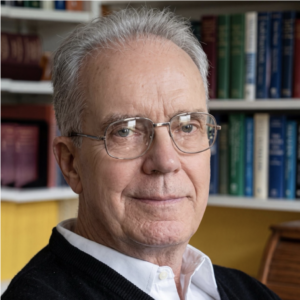
Edward L. Ericson
Edward Lawrence Ericson, longtime Ethical Culture Leader, author, activist, and former president of the American Ethical Union, died on October 1, 2026, at the age of 97. Born January 28, 1929, he spent his youth in Dunedin, Florida, and went on to devote much of his life to Humanism, freedom of conscience, civil rights, peace, and the Ethical Culture Movement.
Ericson studied at St. Petersburg Junior College and Stetson University before earning his Master of Divinity from Starr King School for the Ministry in 1954. He began his religious leadership as a Unitarian minister, serving congregations in Eugene, Oregon, and Fairfax County, Virginia. In 1959, he entered Ethical Culture leadership as Leader of the Washington Ethical Society, beginning an association with the movement that would span decades.
He served the Washington Ethical Society from 1959 to 1971 and then became Leader of the New York Society for Ethical Culture, where he served from 1971 to 1984. From 1969 to 1971, while still in Washington, Ericson also served as president of the American Ethical Union. He contributed to the Ethical Culture School of New York as a member of its Board of Governors and Executive Committee and chaired its Council on Educational Philosophy.
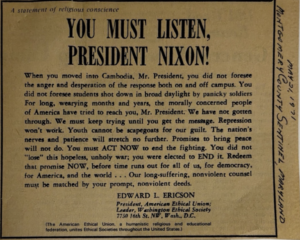
As president of the American Ethical Union and Leader of the Washington Ethical Society, Edward Ericson publicly called on President Richard Nixon to end the war in Southeast Asia in this 1970 statement of religious conscience.
Ericson understood Ethical Humanism as something that belonged not only in meetinghouses and books, but in public life. During his years in Washington and New York, he testified before committees of both the U.S. Senate and House of Representatives on civil liberties, church-state relations, and peace. He served with organizations including the Leadership Conference on Civil Rights, the Civil Liberties Clearing House, and the Washington-area ACLU. He helped organize peace and civil rights demonstrations and participated in Martin Luther King Jr.’s marches in Washington, D.C., and Montgomery, Alabama.
His commitment to freedom of conscience was equally central to his work. Alongside Rabbi Sherwin Wine, Ericson co-founded Americans for Religious Liberty, a national organization devoted to defending church-state separation and freedom of belief. He also worked with fellow Ethical Culture Leader Howard Radest in efforts to secure recognition of conscientious-objector status for Humanists.
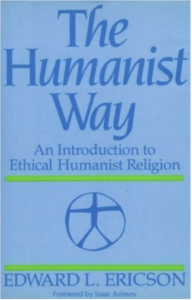
The Humanist Way: An Introduction to Ethical Humanist Religion was one of Edward L. Ericson’s most significant works, offering a clear statement of Ethical Humanism as a positive religious and ethical way of life. The book included a foreword by Isaac Asimov.
Ericson was also an influential writer and interpreter of Humanism. His four books included American Freedom and the Radical Right, The Free Mind Through the Ages, The Humanist Way, and The American Dream Renewed. He also edited Emerson on Transcendentalism and contributed to numerous publications.
Of these works, The Humanist Way: An Introduction to Ethical Humanist Religion has had a particularly lasting place within Ethical Culture. Ericson presented Humanism not simply as a rejection of supernatural belief, but as a positive religious and ethical way of living rooted in human relationships and this world. In a 1978 Platform address, he wrote that Humanists seek “the roots of the spiritual here, in our time and relationships, in our common life.” His understanding of the spiritual life as something discovered through human connection, ethical growth, and engagement with the world continues to resonate within the movement.
Some of the materials preserved from Ericson’s long public life also reveal the reach of his voice. Correspondence in his papers includes letters from figures such as Isaac Asimov, Bill Moyers, and Juliette Huxley. A 1970 public statement issued while he was president of the AEU addressed President Richard Nixon directly over the war in Southeast Asia, insisting that moral concern must be matched by action. These records offer a glimpse of a Leader willing to bring Ethical Humanist convictions into conversation with the defining questions of his time.
Ericson received numerous honors throughout his career, including awards from both the American Humanist Association and Ethical Culture organizations. In 2019, the American Ethical Union presented him with its Felix Adler Lifetime Achievement Award, recognizing a lifetime of service to the movement he had helped shape.
Edward Ericson’s legacy lives in more than the offices he held or the books he wrote. It lives in an Ethical Culture movement he helped carry more fully into modern Humanism; in the defense of freedom of conscience and civil liberties; in the insistence that peace and racial justice are ethical responsibilities; and in generations of Ethical Humanists who continue to wrestle with what it means to build a meaningful life together in this world.
His life reminds us that Ethical Culture is both an inheritance and an undertaking: something we receive, question, deepen, and carry forward.
He is survived by his partner, Carol MacIntyre, members of her family, and his brother, Wallace Ericson.
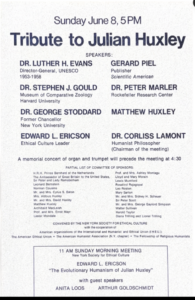
Edward L. Ericson joined leading scientists, writers, and Humanist thinkers for a New York Society for Ethical Culture tribute to Julian Huxley, reflecting Ericson’s longtime role in bringing Ethical Culture into conversation with the wider Humanist movement.


