



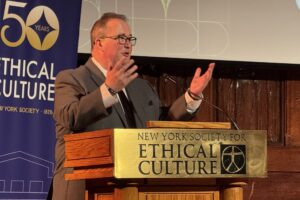
Photo of Steve Serling, NYSEC Board Vice President, from NYSEC Facebook Post
The inscription in the auditorium of the New York Society for Ethical Culture once read, “The place where men meet to seek the highest is holy ground.” Sometime in the late 1980s, one word changed. “Men” became “people.” The word changed because the people who meet there changed, and because a Movement that insists ethics must be lived cannot leave its own walls unexamined.
This is what 150 years of Ethical Culture looks like: not a monument, but a sentence still being revised.
Ellen McBride remembers the old inscription. She joined NYSEC in the 1960s, after her future husband heard Algernon Black on the radio. She remembers Adler Hall before its renovation, an earlier version of a room that has since been revised too. Across the decades, she has watched membership patterns shift and Societies move through cycles of decline and renewal. Yet the basic commitments, she says, have held.
“Things change, but the basic beliefs of Ethical Culture which were espoused by Adler remain the same. The fight for Deed over Creed never ends,” Ellen said.
Her answer to what the anniversary means is brief: “Simply we are still here.” Still here, with people gathering to learn, organize, care, and serve. “The community is what I seek and find,” she said.
Felix Adler launched the Ethical Culture Movement 150 years ago around a single practical idea: ethics must be lived. For Steve Serling, NYSEC Board Vice President, that idea still defines everything.
“For me, it always comes back to Deed above Creed,” Steve said. “That’s what originally drew me to NYSEC more than ten years ago, when my friend Sarah and I were just looking for something meaningful to do on MLK Day.”
The 150th Anniversary Gala brought that ethic to life by spotlighting long-standing partnerships with the Encampment for Citizenship, the NAACP, and 350NYC. “NYSEC has never operated in isolation,” Steve said. “We are part of the fabric of New York City.”
One moment stood out for him: NYSEC’s first street fair on 64th Street, in September 2025. Music, dance, youth activities, friends and partners from across the Movement, and recognition from city officials, a full community effort that, as he put it, “brought people directly into our space and gave them opportunities to learn, connect, and think about how they might take action themselves.”
For Steve, the Movement’s relevance begins with a warm welcome. “You can come as you are, fully and authentically yourself. That wasn’t something I always felt growing up in other faith traditions,” he said.
Still, both Ellen and Steve see room for the Movement to explain itself better. Steve is concerned that the philosophy can feel abstract to newcomers with a busy calendar crowding out explicit ethical reflection.
Ellen, drawing on longer experience, names what she sees as missing. “What is lacking is the education about Ethical Culture before becoming members,” she said.
She wants revived courses, stronger formation, and renewed leadership development, and found reason for hope at the 2025 AEU Assembly.
Carolyn A. Parker’s work with the Ethical Culture Institute offers one response. She describes herself as “a student of Ethical Culture,” and as the anniversary approached, her way of honoring it took the form of study and preservation.
In 2022, she began what she called a “Biblioblog for Ethical Culture,” noting that while others might celebrate by “remembering the past, applauding our accomplishments, toasting the future,” her own interests lay in “the body of writing that Ethical Culture has inspired.”
She suspected that body might not be large. The deeper she looked, the more she found, books, journals, manuscripts, early serials like Ethical Addresses (1895–1914), much of it “scattered, even lost to common view.”
The result is the Bibliography of Ethical Culture, whose first online edition appeared on May 15, 2025, in The Annals of the Ethical Culture Institute at NYSEC. A new edition is planned for the summer issue. Carolyn hopes it will “both inform and inspire our members in their individual pursuits in Ethical Culture.”
That hope speaks to the anniversary’s larger invitation. Ethical Culture has always resisted fixed creeds, but our non-creedal Movement does not carry itself forward automatically. It must be studied, practiced, and renewed by each generation.
On May 31, Ethical Culture communities gathered virtually for a Movement-wide All-Societies Platform celebration. NYSEC holds a unique place in the Movement’s history, but the 150th belongs to everyone.
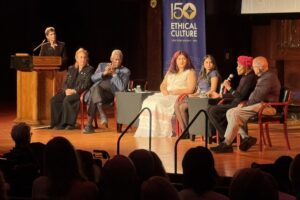
Photo of the 150th Ethical Culture Anniversary Gala from NYSEC Facebook Post
Steve sees a particular opening in this moment. “People are highly connected digitally and, at the same time, often feel more isolated. Ethical Culture has something meaningful to offer here, especially through in-person community rooted in shared values that don’t depend on belief in a higher power. Being part of a community like this makes things feel a little less lonely and a lot more hopeful,” he said.
One hundred and fifty years in, the work is the same as it was at the start: to gather, to act, and to keep asking what an ethical life requires. The answer is not finished. Neither is the Movement.
The 111th AEU Assembly is an opportunity to continue this work together: to learn from one another, strengthen our relationships, and help shape what Ethical Culture is still becoming.
Please consider joining friends from across the Movement and register for the 111th AEU Assembly.
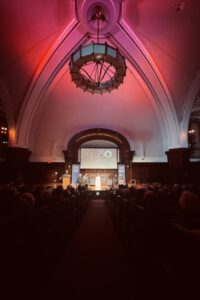
Photo of the 150th Ethical Culture Anniversary Gala from NYSEC Facebook Post


