



A movement’s future depends on people who can carry its values into shared life. Ethical leadership turns ethics into culture, in the decisions we make, the relationships we build, and the communities we shape.
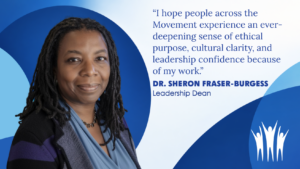
“I hope people across the Movement experience an ever-deepening sense of ethical purpose, cultural clarity, and leadership confidence because of my work,” said Dr. Sheron Fraser-Burgess.
As the American Ethical Union’s Leadership Dean, Sheron is developing new ways to prepare lay and professional leaders with the wisdom, skill, and perseverance to help Ethical Culture communities flourish.
A central part of Sheron’s work will be building momentum for the Leadership Training Initiative, or LTI. She is developing a coordinated set of educational programs for lay leaders and professional Leaders in collaboration with AEU staff and national leadership.
“My first-year priority is to build thoughtful, responsive educational programs that help people grow into ethical leaders,” Sheron said.
The initiative is being designed to develop the whole leader.
“These programs will strengthen character dispositions, build organizational leadership and management skills, and cultivate the personal, interpersonal, and cultural capacities essential to an Ethical Humanist environment,” Sheron explained.
For Sheron, ethical leadership brings competence, character, and community awareness together. The aim is to help people apply ethical values in real situations, serve their communities responsibly, and continue growing through the experience of leadership.
Sheron’s vision has been shaped by her own journey as an educator and ethicist.
Her early study of ethics focused on moral obligation in democratic life. Over time, she came to see ethical reasoning as something expressed through everyday choices, relationships, and shared practices.
“I came to understand that ethical reasoning and culture are lived practices essential to learning and thriving together,” she said.
That insight now guides her approach to leadership education. People need opportunities to study important ideas, but they also need space to reflect, practice, exchange feedback, and learn alongside others.
Through LTI, Sheron hopes to create experiences that strengthen Ethical Societies from within, helping people reason ethically, understand the cultures they are creating, and lead their communities toward a shared vision of living well together.
“My leadership philosophy is rooted in servant leadership, which is the conviction that a leader’s primary role is to support and elevate the people and communities she serves,” Sheron said.
This philosophy places responsibility to others at the center of leadership. It recognizes that every leader works within a larger community shaped by many experiences, identities, interests, and values.
For Sheron, leadership and character are inseparable. Integrity, honesty, empathy, fairness, equality, and justice influence how leaders make decisions, respond to conflict, use authority, and care for the people they serve.
“The morally aware leader understands herself as embedded within a broader social ecosystem in which the interests, values, and identities of each person matter,” she said.
Ethical leaders consider the effects of their choices, listen for perspectives that may be missing, and create opportunities for others to contribute and grow. As Sheron put it, “leaders cultivate virtue, act with moral clarity, and serve their communities with purpose.”
Sheron hopes the impact of this work will be visible in what people and communities experience.
She wants people across the Movement to develop a deeper sense of ethical purpose and a clearer understanding of how their work connects to Ethical Humanist values.
For lay and professional leaders, confidence will come from learning how to think ethically, listen carefully, and make responsible decisions, while continuing to grow through uncertainty.
Sheron wants the initiative to become “a resource that genuinely helps Societies grow as communities of collective living and ethical action.”
Stronger leaders can help build healthier relationships, principled cultures, and communities that are better prepared to act on their values.
Leadership develops through relationships. People grow by accepting responsibility, listening across differences, receiving honest feedback, reflecting on their experiences, and applying what they learn.
Sheron envisions the initiative as “a platform for transformative educational experiences undertaken in community with others.”
That emphasis reflects a central truth about ethical leadership: leaders grow alongside people who challenge them, encourage them, hold them accountable, and invest in their development.
The Leadership Training Initiative offers the Ethical Culture Movement an opportunity to deepen its shared understanding of leadership. What qualities do our communities need from the people who guide them? How can leaders bring competence, compassion, and cultural awareness to their work? How can we create communities in which leadership is shared, supported, and rooted in our values?
These questions belong to the entire Movement.
As Sheron begins this work, she invites us to understand leadership formation as a shared ethical practice, one that helps people grow, strengthens the Societies they serve, and prepares the Movement for the work ahead.


